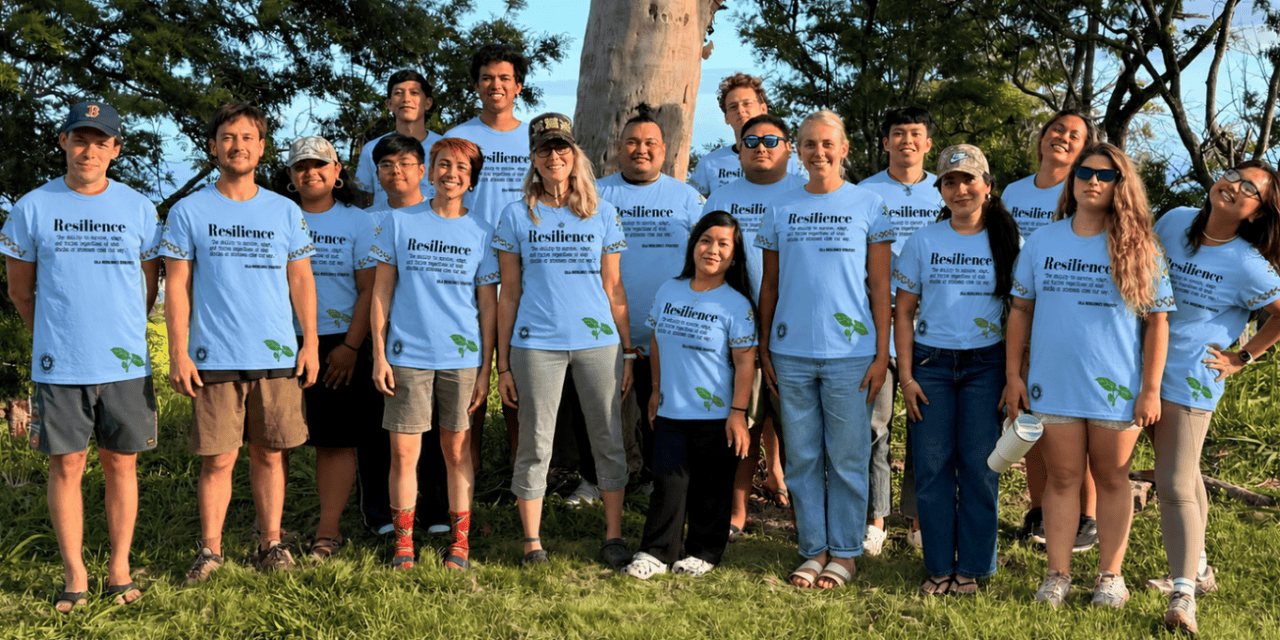
CERENE, led by Dr. Miku Lenetine (in a hat in the front row), has helped KCC students gain real-world experience in helping their communities.
By Geneva Mellison | Staff Writer
Like many of you after the recent storms, I found myself wondering how to prepare for a natural disaster. KCC has been preparing.
Dr. Miku Lenetine, professor of Environmental Science, is the director of the program CERENE, which stands for Community Engagement for Resilient Neighborhoods. CERENE’s mission is to bridge KCC students with the local communities for resilience work, sustainability, and natural disaster resource planning.
Although CERENE is housed at KCC, it embeds students within the local government and neighborhood board meetings. In this program, there are currently 15 KCC students acting as Resilience Corps Leaders (RCLs) spread across three programs: Resilience Hub RCLs, Lē‘ahi RCLs, and X Gen RCLs
“So it’s kind of an amazing thing because we’re designing a community-based research program and research center here, but only as long as students are integrated into all of it, because that’s the mission of KCC, right?” said Lenetine.
RCLs are a core leadership initiative that trains students in sustainability and disaster preparedness through community service and civic engagement. The program begins by empowering students and placing them with different communities, working with the city to help support resilience hubs. In the past, they have stocked shelves or tended to community gardens. Now, in addition, they are given leadership roles, helping facilitate meetings, and coming up with multiple ways to make these communities stronger.
“That’s a simple mission, but it’s actually quite a grand one,” Lenentine said.
The Lē‘ahi RCL tends and maintains a small park, Muriel Flanders Park, at the base of Lē‘ahi. According to Lenetine, the family of Flanders was so happy with the work accomplished last year, they created a foundation, donating $1,000 per semester for every student leader to continue this work.
The newest program, X Gen RCL, works with a group called the Kūpuna Collective, and they are associated with the Center on Aging at University of Hawai‘i at Mānoa. Students will get placed with a kūpuna, the Hawaiian word for grandparents and respected elders, who will mentor and meet once a month, picking a project to strengthen kūpuna resilience response.
“Normally those are the first people on our call list that we need to check on,” Lenentine said. “They’re the ones that can’t get out of their houses. They’re the ones that need the most hope.”
Student leaders with the kūpuna are going to come up with one project to help strengthen elderly response for these particular resilient hubs. Lenentine is looking to recruit two more students for hubs for the entire school year and potentially the summer as well.
“Our students definitely go from being kind of quieter or more nervous, to growing in confidence, to being able to show up at neighborhood board meetings,” Lenentine said. “Though they’re nervous, they’re doing that.”
Student leader Kai Yamasato is a Hawaiian Studies major from Mānoa in his second year at KCC. He attended a summer program at Camp Pālehua, located in Kapolei, where they collaborated with the community to create stronger resilience hubs across the island. Here alongside his team members, Yamasato engaged with the community, playing games with keiki, and connected generational knowledge with modern resilience approaches.
“It’s like the kūpuna would say, ‘Oh, you have to kilo, or watch your surroundings, use the five senses,’ and most people aren’t taught that,” Yamasato said.“Then, from a science, or ʻāina perspective, it’s more about the growth of the environment but not the hidden knowledge behind it. [CERENE] bridges indigenous knowledge and working in ʻāina together.”
Resilience Hub member Levi Scotte grew up in Kahala, and majors in Philosophy and Economics while working towards a sustainability certificate. He joined CERENE last summer doing administrative work, then transitioned into one of the RCLs.
Scotte spoke about his summer spent with his cohort, connecting with his classmates and gaining a better understanding of the efforts put into community work, and how fulfilling it is to be a part of it.
“Everyone here is amazing, and they do a lot of really good and important work,” Scotte said. “I’ve learned the importance of how community is the first response. Police and public officials aren’t able to send out help for a couple days. That’s something that I didn’t realize before.”
CERENE member meetings are held over Zoom every Tuesday night. Through smiles and laughter, the students share the work they are doing to help their local communities.
“They’re all getting a ton of professional experience,” Lenetine said, “but they’re having a lot of fun while they’re doing it.”